Why Visa Interviews Should Feel Like A Conversation And Not An Exam
There’s a moment many visa applicants experience before interviews, they stop preparing to communicate, and start preparing to perform.
Questions become flashcards. Answers become scripts. Every sentence starts feeling like something that must be delivered correctly.
At first, this feels responsible. After all, visa interviews feel important.
So applicants prepare the way they’ve been rewarded for preparing most of their lives:
like exams.
Study enough.
Memorize enough.
Avoid mistakes.
Get approved.
But interviews do not work the same way, and this is where many applicants unintentionally create more pressure for themselves, because visa interviews are not designed to reward perfect recall. They are conversations happening under pressure, and conversations behave differently.
Why Students Prepare Like Exams
Most students are incredibly experienced at succeeding in structured environments.
School rewards:
preparation,
correct answers,
consistency,
predictability.
Over time, this creates an understandable belief:
If I prepare enough, I should be able to control the outcome.
That mindset works surprisingly well in academics. It becomes less reliable in interviews because interviews introduce something exams rarely do:
another human.
And humans change conversations.
Questions shift. Follow-ups appear. Conversations move unexpectedly.
Applicants who prepare only for ideal wording often feel destabilized when reality becomes less predictable, not because they are underprepared, but because they prepared for recall instead of interaction.
Why Conversations Can't Be Memorized
One of the biggest differences between an exam and a conversation is that conversations are shared experiences. You are not simply delivering information—you are responding to another person's questions, reactions, and follow-ups in real time.
That means no two visa interviews unfold exactly the same way. Two applicants may be asked similar questions, but the order, phrasing, or follow-up questions can vary depending on how the conversation develops. Preparing for only one version of that conversation can create unnecessary pressure.
Instead of memorizing exact responses, it is often more helpful to understand the reasons behind your decisions. When you understand your own story well, you can explain it naturally regardless of how a question is asked.
The Problem With “Correct Answers”
One of the biggest misconceptions applicants carry into interviews is believing every question has an ideal response.
Questions like:
Why this university?
Why this course?
What are your future plans?
start feeling dangerous.
Applicants begin searching for:
safest wording,
approved structures,
high-scoring responses.
Eventually, something strange happens. The answers become increasingly polished, but the conversation becomes less natural. Applicants spend so much effort sounding correct that they sometimes stop sounding like themselves.
What began as preparation gradually turns into performance. That difference matters.
"The goal isn't to find the perfect answer. It's to explain your real answer clearly."
Conversation Signals Versus Factual Recall
Applicants often assume interviews evaluate information, but conversations evaluate more than information.
People naturally notice things like:
rhythm,
comfort,
structure,
responsiveness,
and conversational flexibility.
Two applicants can communicate nearly identical facts. One sounds convincing, the other sounds memorized. Why? Because communication carries behavioral signals.
A conversational answer usually feels:
clear,
specific,
and connected.
A performed answer often feels:
optimized,
rigid,
or emotionally distant.
That doesn’t mean applicants should become casual. It means interviews tend to reward understanding more than repetition.
Listening Is Part Of Communication
Many applicants think their job is simply to answer questions, but strong communication also involves listening carefully. When applicants become too focused on remembering their next answer, they sometimes stop paying full attention to the question being asked.
This can lead to answers that are only partially relevant or that include unnecessary information. Listening carefully before speaking allows you to respond to the actual question rather than the one you expected to hear. It also makes the conversation feel more natural and reduces the pressure to rely on memorized scripts.
Staying Present During Interviews
One of the fastest ways communication breaks down is when applicants stop participating in the conversation. Instead, they start monitoring themselves.
Thoughts become:
Did that sound okay?
Am I speaking correctly?
Should I say more?
Was that suspicious?
The conversation disappears. Self-evaluation takes over. Interestingly, strong communicators often do something simpler.
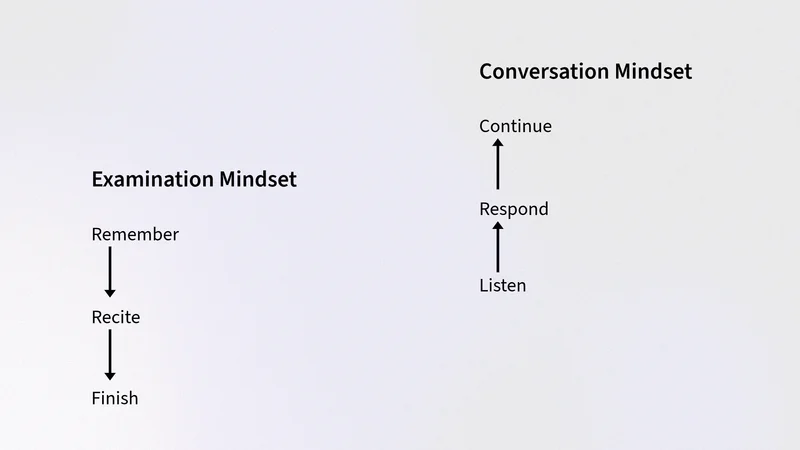
They stay with the question, they answer, they listen, then they continue. That presence creates smoother communication, not because they are fearless, but because attention stays inside the conversation instead of inside self-monitoring.
Examination Mindset Vs Conversation Mindset
Practicing Natural Speaking
Natural communication sounds effortless, usually it isn’t, it is practiced but not through memorizing ideal answers. Through repetition in realistic conditions.
One useful exercise:
Take common visa questions. Answer them three different ways, not to find the perfect version, to prove to yourself there isn’t only one.
That small exercise changes something important. It reduces dependence on exact wording, and once wording becomes flexible, conversations start feeling safer.
Another useful rule:
If your answer only works one way—you probably don’t understand it deeply enough yet. Strong preparation should help applicants become comfortable expressing ideas naturally. Not performing them.
Many applicants accidentally turn visa interviews into exams. They collect answers, rehearse wording, and try to eliminate uncertainty but interviews are not memory tests. They are conversations.
And conversations reward different skills:
clarity,
adaptability,
presence,
and natural communication.
Preparation gives you the knowledge to answer questions. Communication allows you to share that knowledge in a way another person can easily understand. Both matter—but only one can turn an interview into a genuine conversation.
But the goal is not becoming impossible to challenge. The goal is becoming comfortable enough with your own story that you can explain it naturally—even when the conversation changes.
Conversations Build Trust Through Clarity
Most meaningful conversations don't feel impressive because people use sophisticated language. They feel comfortable because ideas are communicated clearly and honestly.
Visa interviews work in a similar way. Applicants don't need to sound like they've rehearsed every sentence. They need to explain their decisions in a way that feels logical, consistent, and easy to follow.
When applicants stop trying to impress and start trying to communicate, interviews often become less stressful. Instead of searching for the "perfect" answer, they focus on making their reasoning easy to understand. That small shift can dramatically improve the quality of the conversation.
At Interviewivy, we believe confidence grows through realistic conversation practice because the strongest interviews rarely sound rehearsed. They sound understood.