Why Feedback Often Improves Interviews More Than More Practice
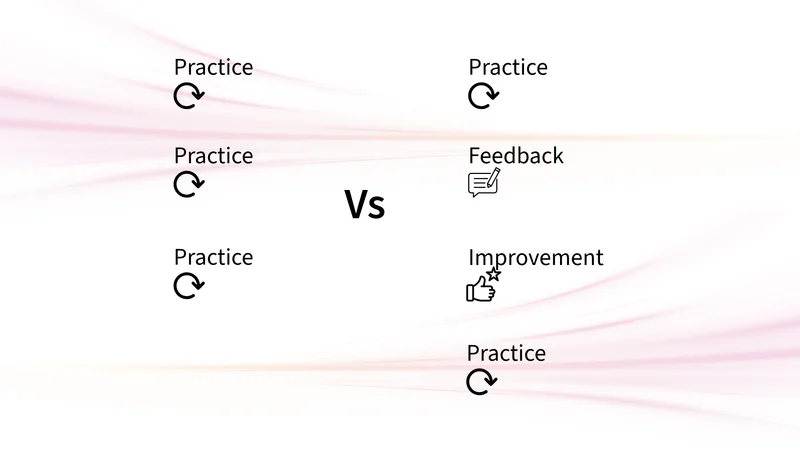
Practice feels productive. That feeling is one reason people trust it so easily.
When applicants prepare for interviews, the instinct is usually straightforward: do more questions, repeat answers, and keep going until responses feel smoother. More practice creates movement, and movement feels like progress.
Sometimes it is.
But practice has a blind spot. If the underlying communication pattern does not change, repetition can quietly reinforce the same habits instead of improving them. Applicants become more familiar with their responses while staying unaware of the behaviors that continue limiting them.
That is why some people prepare extensively and still feel disappointed by actual interview performance.
The issue is not always effort. Sometimes it is direction.
The Repetition Trap
Repetition is useful because familiarity reduces uncertainty.
Questions feel less surprising. Thoughts become easier to access. Pressure feels slightly more manageable.
But repetition also creates confidence quickly, and confidence can be misleading.
Applicants often assume improvement because answers become easier to deliver. In reality, they may simply be becoming more comfortable repeating the same communication patterns.
Someone who over-explains can become faster at over-explaining.
Someone who answers indirectly can become more polished at answering indirectly.
Someone who sounds rehearsed can become more fluent without becoming more natural.
Practice creates exposure but exposure alone does not guarantee adjustment.
Practice Versus Correction
One of the easiest mistakes during preparation is treating practice and improvement as interchangeable.
They are related, but they are not identical. Practice creates opportunities to observe. Correction creates change.
That distinction matters because communication problems are often subtle. People rarely notice them while actively participating in a conversation.
An answer may feel detailed while sounding difficult to follow.
A response may feel thoughtful while becoming too long.
Someone may believe they sound confident while actually sounding controlled or memorized.
Without some form of observation, those patterns can remain invisible even after dozens of practice sessions.
That is where feedback becomes useful, not because feedback replaces practice because it changes what practice teaches.
Identifying Communication Patterns
Most applicants focus heavily on content.
Did I answer correctly? Did I forget anything? Was my explanation strong enough? These questions matter.
But communication patterns often shape outcomes more quietly.
Applicants sometimes discover that they consistently begin answers too quickly, interrupt their own explanations, lose structure after follow-up questions, or continue speaking long after the original question has been answered.
These are difficult habits to detect from inside the conversation.
Once patterns become visible, preparation becomes easier to improve.
People stop trying to become universally better, they start making targeted adjustments. That usually produces more progress than simply repeating more questions.
Small Improvements Compound
One reason feedback feels powerful is because communication rarely improves all at once. Most progress arrives through small corrections.
Shorter pauses. Clearer structure. More direct answers. Better pacing. Less internal editing.
Each change feels insignificant in isolation but interviews are cumulative experiences.
Small improvements repeated across many responses gradually change how communication feels.
That is why progress sometimes appears suddenly even though improvement happened slowly.
People notice the outcome after many small adjustments have already accumulated.
Building A Feedback Loop
A useful preparation loop is surprisingly simple.
Practice. Observe. Adjust. Repeat.
The goal is not becoming overly analytical or constantly evaluating every sentence. The goal is reducing blind spots.
That process changes the question from:
How much have I practiced?
to:
What changed after practicing?
Those are different preparation philosophies.
One measures effort, the other measures adaptation.
At Interviewivy, we believe realistic practice becomes more valuable when applicants can understand what communication actually looked and felt like—not just how it felt internally.
Practice creates exposure. Feedback creates progress.
And over time, progress usually comes from seeing patterns that repetition alone would not reveal.