The Small Communication Habits Visa Applicants Usually Miss
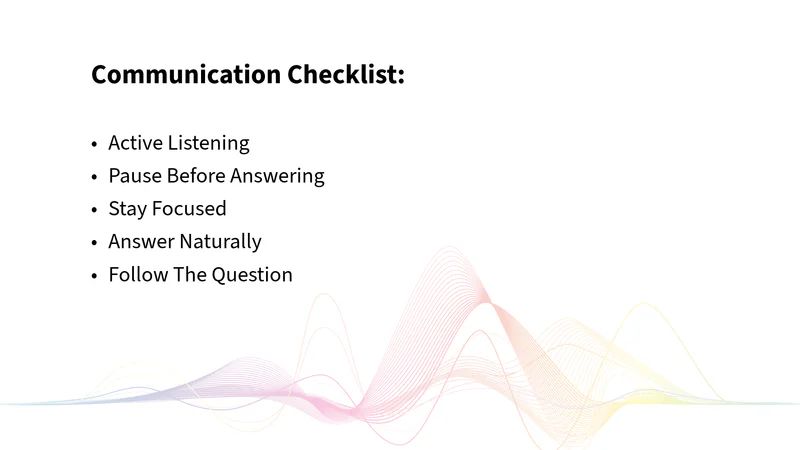
Most applicants assume interviews are decided by answers.
That assumption makes preparation feel straightforward. People focus on collecting information, refining responses, remembering examples, and making sure nothing important gets forgotten.
But interviews rarely feel the way preparation imagines them.
Two applicants can communicate similar ideas and create very different impressions. One feels easier to follow. One feels calmer. One feels more credible. Often the difference is not knowledge.
It is behavior.
Small communication habits quietly shape how answers are experienced, and many of them are difficult to notice while speaking.
That is why interviews sometimes feel unpredictable. People prepare content and underestimate delivery.
Speaking Speed Changes More Than People Realize
Speaking quickly is not automatically a problem.
Many applicants speak faster under pressure simply because thinking speeds up. They want to answer immediately, avoid awkward pauses, and show engagement.
The problem appears when speed begins controlling structure.
Ideas start overlapping.
Sentences become less deliberate.
Applicants reach the end of an answer and realize they explained more than they intended.
Interestingly, this often feels normal from the inside.
People remember what they meant to say and assume it sounded equally clear.
But listeners experience communication differently.
They experience pacing.
Small adjustments in speaking speed often create more clarity than adding more content.
Over-Explaining Usually Starts With Good Intentions
Most over-explaining does not come from uncertainty.
It comes from wanting to be understood.
Applicants worry that short answers may sound incomplete, so they begin adding context, examples, clarification, and extra reasoning.
That instinct makes sense.
But interviews are cumulative experiences.
When every answer becomes slightly longer than necessary, conversations slowly become harder to follow.
Longer communication does not always feel more convincing.
Often it feels more difficult to process.
Applicants rarely notice this because answers still feel organized internally.
But listeners experience length differently than speakers do.
Filler Patterns Create Hidden Friction
Many communication habits become visible only after repetition.
People begin every answer the same way.
They insert unnecessary transitions.
They correct themselves mid-sentence.
They use filler phrases while buying time.
Individually, these habits rarely matter.
Repeated consistently, they change how communication feels.
Listeners start focusing on the rhythm instead of the meaning.
What makes filler patterns difficult is that they often feel invisible while speaking.
People remember the idea.
Not the path used to reach it.
That is why habits are usually easier to observe afterward than during the conversation itself.
Structure Is Often More Important Than Completeness
Applicants frequently assume strong communication means saying enough.
But communication is often judged differently.
People remember structure more than volume.
A response that begins clearly, develops naturally, and ends intentionally often feels stronger than a longer answer containing more information.
That does not mean simplifying everything.
It means helping listeners move through ideas without unnecessary effort.
Strong communicators are not always more knowledgeable.
They often make understanding easier.
That distinction becomes surprisingly important under pressure.
Awareness Changes Preparation
One of the most useful moments during preparation is realizing that communication creates patterns.
People discover they always speed up during difficult questions.
Or they explain too much once they become nervous.
Or they stop listening after preparing a response internally.
Those observations change preparation because they shift attention.
Instead of asking:
What should I practice?
People begin asking:
That change usually produces better improvement than adding more repetition.
At Interviewivy, we believe preparation becomes more useful when applicants can observe how communication behaves under pressure instead of assuming good answers automatically create strong interviews.
Because communication is often shaped less by major mistakes and more by small habits repeated consistently.