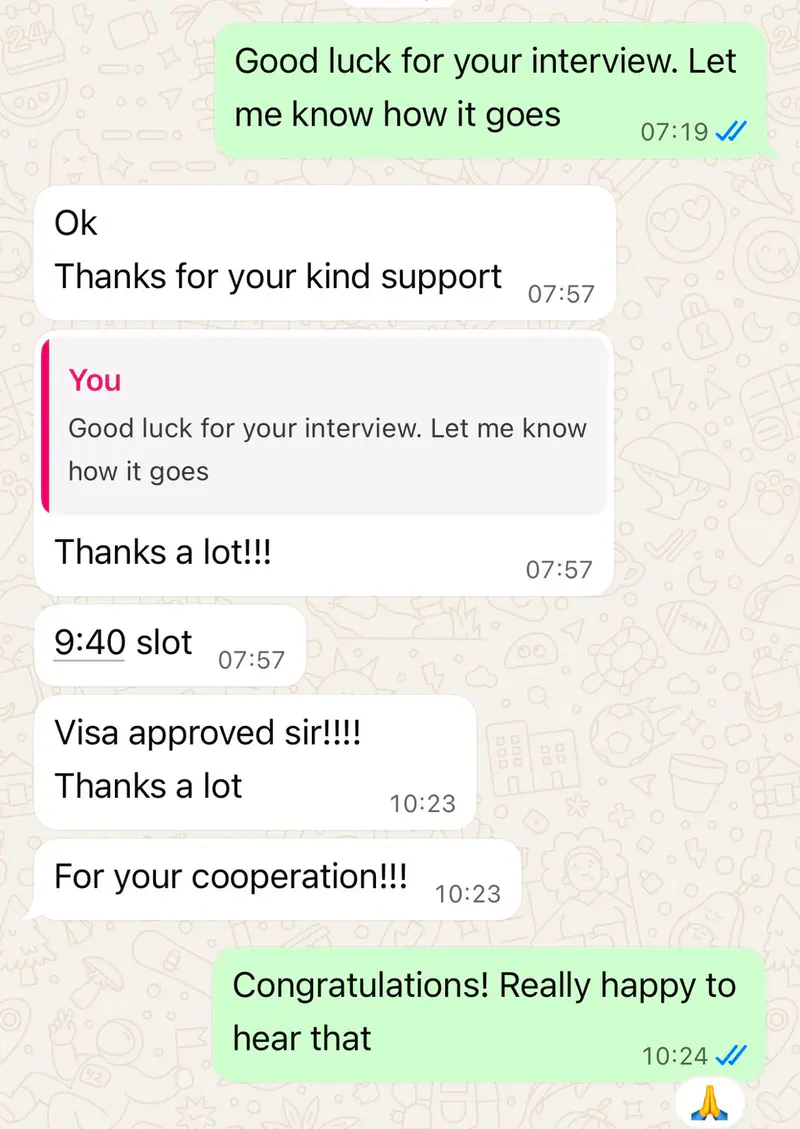
Most case studies get written about ideal conditions. This one isn't that. Nisha, an Interviewivy user applying for a B2 visa from India to attend her undergraduate reunion, had her interview scheduled for the next day when she ran into a technical issue on the platform. This is what happened in the 17 hours between that phone call and her approval.
The Problem: A Technical Glitch, One Day Out
Nisha had signed up for Interviewivy specifically to prepare for her B2 visa interview — a reunion trip with her undergraduate friends, her first time applying for a U.S. visa, with no prior international travel history to lean on. When she tried to start practicing, the platform kept freezing on her screen, most likely tied to using it on mobile. For most users, a technical hiccup is an annoyance. For Nisha, with her interview scheduled for the following day, it was close to a crisis.
Our team reached out to her directly to understand what had gone wrong. That call is really where this story starts.
The Intervention: A Live Coaching Call, 17 Hours Out
Rather than just troubleshooting the technical issue and leaving her to figure out the rest, our team set up a direct call with Nisha. We asked her to run through one full mock interview live, on the phone, so we could actually hear what was happening — not guess at it.
What we heard was a common but fixable pattern: Nisha's English was noticeably broken, her answers were short and unstructured, and several of the things a B2 officer specifically listens for were either missing entirely or buried too deep in her answers to register in a short interview window.
We gave her direct, specific feedback on five things:
State her funding source clearly. Not implied, not assumed — said plainly and early in the answer.
Speak the way she was speaking to us on the call — calm, natural, conversational — rather than the stiffer, more clipped tone she'd been using in practice.
Use the B2 question bank as a reference, not a script. Read the likely questions, understand what each is really asking, but answer in her own words rather than reciting.
State her return intent clearly and precisely. Not "I will come back," but specific, concrete reasons why.
Explain her ties to home directly — family, work, or other obligations that make her return the obvious, natural outcome rather than something she had to be convinced of.
We also pointed her to our B2 visa interview question bank so she had real reference material to work from between sessions, and when she ran low on practice credits partway through the day, we added more so a technical limit wouldn't be the reason she went in underprepared.
The Practice Arc: 9 Sessions, Two Days
Nisha didn't do one polished run-through and call it done. She practiced six sessions spread across the day after our call, and completed three more the following morning before actually leaving for her appointment.
The improvement showed up in her scores, not just in how she felt about it:


That's not a story about talent suddenly appearing overnight — it's what repeated, specific-feedback practice does when someone is coachable and puts in the reps. Her English didn't become fluent in a day. What changed was structure, clarity, and confidence in hitting the specific points a B2 officer needs to hear.
The Outcome
Nisha's B2 visa was approved. First-time applicant, no international travel history, broken English, a technical setback the day before her interview — and an approval anyway, built almost entirely in the final 17 hours before she walked in for her visa interview.
She told our team afterward that she wished she'd found the platform earlier, rather than discovering it the day before her interview. It's a fair point — and also a reminder that even a genuinely late start with focused, specific practice can still move the needle significantly. We told her the same thing we'd tell anyone in her position: with real practice, she'd get there. She did.
What Other Applicants Can Take From This
You don't need a support team on the phone with you to apply the same fixes Nisha used. The five things we coached her on aren't specific to her situation — they're the same five things almost every B2 applicant should be checking their own answers against:
Is your funding source stated clearly, not implied?
Do you sound like yourself, or like you're reciting something?
Are you using the question bank to understand intent, not to memorize a script?
Is your return intent specific, not just a general statement?
Are your ties to home concrete — named, not vague?
If you're reading this the night before your own interview and feeling behind, Nisha's timeline is worth remembering: her real preparation happened in under 24 hours, across 9 sessions, starting from a low score and broken English. Late isn't the same as too late.
Nisha's story isn't a promise that everyone gets approved, and we're not presenting it as one — outcomes depend on each applicant's individual circumstances, and 214(b) refusals happen even to well-prepared candidates. What her story does show is that the gap between an unprepared, low-scoring first attempt and a confident, approved interview can close faster than most applicants assume, if the practice is specific and the feedback is real. If your interview is coming up and you're not sure where you stand, the only way to actually find out is to run through it once, honestly, before it's the real thing.
Nisha: I wish I had found Interviewivy earlier but the quick support and additional mock interview credits for practice helped me get my visa approved.